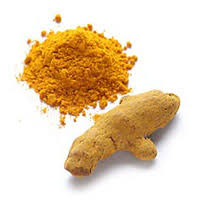
Turmeric
From Wikipedia, the free encyclopedia
Scientific classification
Kingdom: Plantae
Order: Zingiberales
Family: Zingiberaceae
Genus: Curcuma
Species: C. longa
Turmeric (Curcuma longa) is a rhizomatous herbaceous perennial plant of the ginger family, Zingiberaceae which is native to tropical South Asia. It needs temperatures between 20° C and 30° C, and a considerable amount of annual rainfall to thrive. Plants are gathered annually for their rhizomes, and re-seeded from some of those rhizomes in the following season.
It is often misspelled (or pronounced) as tumeric. In medieval Europe, turmeric became known as Indian Saffron, since it is widely used as an alternative to far more expensive saffron spice.
Its rhizomes are boiled for several hours and then dried in hot ovens, after which they are ground into a deep orange-yellow powder commonly used as a spice in curries and other South Asian and Middle Eastern cuisine, for dyeing, and to impart color to mustard condiments. Its active ingredient is curcumin and it has an earthy, bitter, peppery flavor and a mustardy smell.
Sangli, a town in the southern part of the Indian state of Maharashtra, is the largest and most important trading centre for turmeric in Asia or perhaps in the entire world.
Medicinal uses
In Ayurvedic medicine, turmeric is thought to have many medicinal properties and many in India use it as a readily available antiseptic for cuts, burns and bruises. Practitioners of Ayurvedic medicine say it has fluoride which is thought to be essential for teeth. It is also used as an antibacterial agent.
It is taken in some Asian countries as a dietary supplement, which allegedly helps with stomach problems and other ailments. It is popular as a tea in Okinawa, Japan. It is currently being investigated for possible benefits in Alzheimer's disease, cancer and liver disorders.
Turmeric rhizome
It is only in recent years that Western scientists have increasingly recognised the medicinal properties of turmeric. According to a 2005 article in the Wall Street Journal titled, "Common Indian Spice Stirs Hope," research activity into curcumin, the active ingredient in turmeric, is exploding. In that year supplement sales increased 35% from 2004, and the U.S. National Institutes of Health had four clinical trials underway to study curcumin treatment for pancreatic cancer, multiple myeloma, Alzheimer's, and colorectal cancer.
A 2004 UCLA-Veterans Affairs study involving genetically altered mice suggests that curcumin, the active ingredient in turmeric, might inhibit the accumulation of destructive beta amyloids in the brains of Alzheimer's disease patients and also break up existing plaques. "Curcumin has been used for thousands of years as a safe anti-inflammatory in a variety of ailments as part of Indian traditional medicine," Gregory Cole, Professor of medicine and neurology at the David Geffen School of Medicine at UCLA said.
Curcumin has been identified as a powerful MAO-A inhibitor, at doses above 150 mg/kg. MAO-B inhibition was not present until doses escalate above 550mg/kg.
Another 2004 study conducted at Yale University involved oral administration of curcumin to mice homozygous for the most common allele implicated in cystic fibrosis. Treatment with curcumin restored physiologically-relevant levels of protein function.
Anti-tumoral effects against melanoma cells have been demonstrated.
A recent study involving mice has shown that turmeric slows the spread of breast cancer into lungs and other body parts. Turmeric also enhances the effect of taxol in reducing metastasis of breast cancer.
Curcumin is also thought to be an antinociceptive agent (pain reliever). In the November 2006 issue of Arthritis & Rheumatism, a study was published that showed the effectiveness of turmeric in the reduction of joint inflammation, and recommended clinical trials as a possible treatment for the alleviation of arthritis symptoms. It is thought to work as a natural inhibitor of the cox-2 enzyme, and has been shown effective in animal models for neuropathic pain secondary to diabetes, among others.
Presenting their findings at the Endocrine Society’s annual meeting in San Francisco in June 2008, researchers discovered that turmeric-treated mice were less susceptible to developing type 2 diabetes, based on their blood glucose levels, and glucose and insulin tolerance tests. They also discovered that turmeric-fed obese mice showed significantly reduced inflammation in fat tissue and liver compared to controls. They speculate that curcumin in the turmeric lessens insulin resistance and prevents type 2 diabetes in these mouse models by dampening the inflammatory response provoked by obesity.